
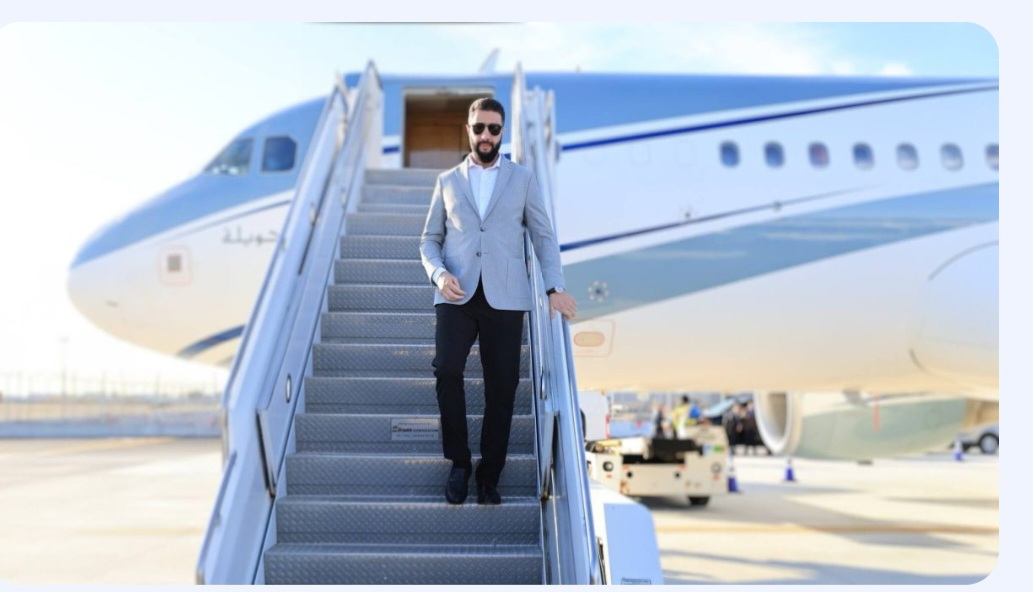
Syrian President Ahmed Sharaa has arrived in Washington for talks with US President Donald Trump, just two days after the US lifted terrorism sanctions against him.
The visit comes eleven months after Sharaa’s forces ousted Bashar al-Assad.
Talks will focus on joint efforts against the Islamic State, following Syria’s arrest of 71 suspected IS members.
Once known as Muhammad al-Jawlani, Sharaa led Hayat Tahrir al-Sham (HTS), formerly linked to al-Qaeda, before severing ties in 2016.
His removal from the US terror list and lifting of HTS sanctions mark a major diplomatic shift, recognizing Syria’s new leadership.
Sharaa, seeking to rebuild Syria’s global standing, has pledged a moderate government and reforms amid ongoing sectarian tensions and instability.
Al-Sharaa’s arrival in the US capital came late on Saturday as Syria’s Ministry of Interior announced launching a “large-scale security operation” across the country, targeting ISIL cells.
Al-Sharaa, whose rebel forces ousted longtime ruler Bashar al-Assad late last year, is due to meet US President Donald Trump at the White House on Monday.
It is the first such visit by a Syrian president since the country’s independence in 1946, according to analysts. Al-Sharaa, who had met Trump for the first time in Riyadh in May, was removed from a US “terrorist” sanctions list on Friday.
US envoy to Syria Tom Barrack said earlier this month that al-Sharaa would “hopefully” sign an agreement to join the international US-led alliance against ISIL.
Washington is also preparing to establish a military presence at an airbase in Damascus to help enable a security pact that the US is brokering between Syria and Israel, according to the Reuters and AFP news agencies. Syrian state news agency SANA has quoted a Syrian foreign ministry source as denying the reports.
For his part, al-Sharaa is expected to seek funds for Syria, which faces significant challenges in rebuilding after 13 years of brutal war. The World Bank has estimated that the cost of reconstruction could take at least $216bn, a figure that it described as a “conservative best estimate”.