

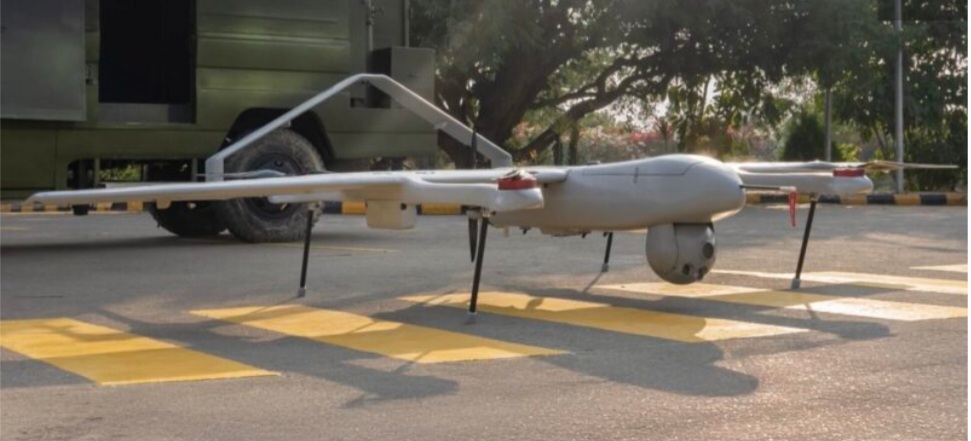
A new long-range, high-endurance unmanned aerial vehicle (UAV) from India is aiming to extend the reach of intelligence, surveillance, and reconnaissance (ISR) missions.
Known as CHEEL, the drone offers an operational range of up to 100 kilometers (62 miles) and flies at altitudes reaching 5,000 meters (16,404 feet).
It has a maximum take-off weight of 80 kilograms (176 pounds), measures 5 meters (16.4 feet) in length, and boasts a wingspan of 3.4 meters (11.2 feet).
Developed by Dynauton Systems, CHEEL can carry multiple ISR payloads, including a 30x optical zoom day camera, a mid-wave infrared sensor, and a laser rangefinder.
The drone is also designed with reduced radar and acoustic signatures, alongside limited resistance to jamming and electronic warfare threats.
For deployment flexibility, the platform supports vertical takeoff and landing (VTOL), allowing operations from confined or unprepared locations such as ship decks, forest clearings, or urban environments.
The UAV can operate in temperatures ranging from −20 degrees Celsius (−4 degrees Fahrenheit) to 45 degrees Celsius (113 degrees Fahrenheit) and offers an endurance of up to 6 hours.
CHEEL is powered by the Orbital 150 heavy-fuel engine from Australian firm Orbital UAV, featuring a 150cc two-stroke design compatible with JP-8 and diesel fuel.
One of the drone’s more distinctive features is its multi-engine architecture, which allows operators to integrate propulsion systems from European, Australian, or Indian manufacturers.
The approach is intended to keep the platform adaptable to different operational requirements, customer preferences, and export-control restrictions.
By supporting multiple engine configurations, Dynauton Systems can also tailor the UAV to meet the technical and regulatory demands of different international markets.