

Israeli strikes on southern Lebanon killed 17 people on Monday, Lebanon’s health ministry says – marking one of the deadliest few days there since a ceasefire began just over two weeks ago.
It brings the number of those killed since Thursday to 110 , according to the ministry. Israel says it is targeting the armed Shia Islamist group Hezbollah.
The Lebanese casualty figures do not distinguish between civilians and combatants. However, two of the dead and 14 of the injured are children.
Israel says 17 of its soldiers have been killed during the same period and accuses Hezbollah of firing hundreds of rockets and drones. Both sides accuse the other of violations, and diplomatic efforts to halt the fighting have so far failed.
On Monday, Israeli Army spokesman Avichay Adraee urged residents in several villages to move at least 1km (0.6 miles) from their homes.
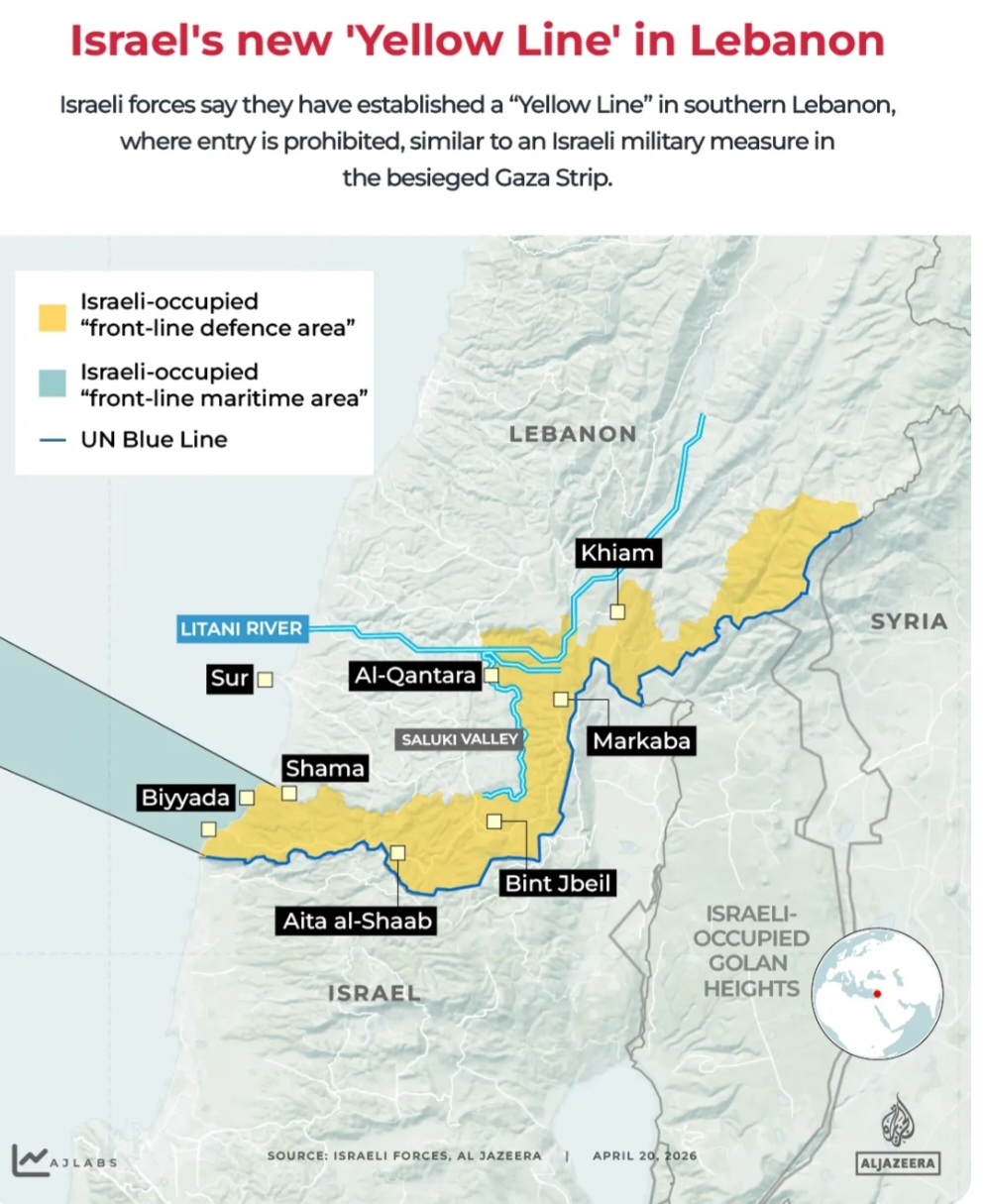
The villages are all located outside the “yellow line”- a strip of Israeli-occupied territory extending roughly 10km from the Lebanese-Israeli border, where Israel says it continues to operate against threats, and which it regards as outside the terms of the ceasefire.
The Israeli military maintains that the agreement permits it to act against “planned, imminent or ongoing attacks”. Lebanese officials dispute that interpretation and accuse Israel of repeated violations.
Hezbollah has also acknowledged carrying out a series of attacks, including drone strikes on Israeli soldiers in Naqoura, in the south of Lebanon close to the Israeli border, and rocket fire at troops in Qantara – in the south-east of the country. The group described those attacks as retaliation for Israeli bombardment of southern Lebanese villages.
Hezbollah also claimed earlier strikes using artillery and what it called “kamikaze drones”.
Israeli Prime Minister Benjamin Netanyahu acknowledged the growing threat posed by Hezbollah’s drone capabilities, warning that it “will take time” to address.
Rounds of talks between Israel and Lebanon in the US, though symbolically significant as the first direct ambassador-level contact in decades, have produced no tangible results on the ground.
Lebanon’s President Joseph Aoun has called on Israel to fully implement the ceasefire before any further negotiations can proceed.
Israel’s military has issued new displacement orders to residents in towns and villages in southern Lebanon, including areas beyond its current zone of occupation, despite a truce meant to halt fighting with the armed group Hezbollah.
“For your safety, you must evacuate your homes immediately and move away from the villages and towns by at least 1,000 metres [0.6 miles] into open areas,” the Israeli military’s Arabic-language spokesman Avichay Adraee posted on X on Sunday.
The warning covers more than 10 villages and towns, including several in the district of Nabatieh that lie north of the Litani River, south of which Israel has stationed troops.
Lebanon’s state-run National News Agency later reported a series of Israeli strikes across southern Lebanon, including on towns not mentioned in the displacement order.
On Wednesday, Israel’s military chief of staff, Eyal Zamir, had threatened to strike Hezbollah “beyond the Yellow Line”, which marks the area of Israeli control.
“Any threat, anywhere, against our communities or our forces – including beyond the Yellow Line and north of the Litani – will be eliminated,” he said during a visit to Israeli troops.
In the past week, two soldiers and an army contractor have been killed by drone attacks in the area and dozens of soldiers wounded.