

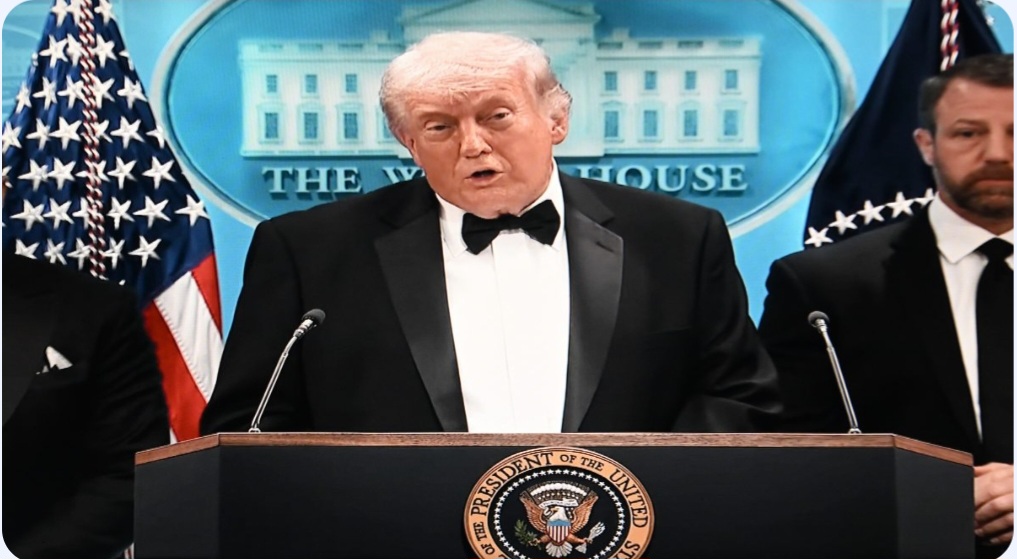
US President Donald Trump today claimed that Tehran has consented to long-term, comprehensive monitoring of its nuclear infrastructure. Concurrently, Washington will ease shipping constraints in the Strait of Hormuz and release bound financial concessions, subject to stringent American oversight.
In a detailed statement on social media platform, President Trump asserted that the Iranian leadership had conceded significant ground during the ongoing diplomatic talks, which seek to establish a comprehensive peace framework following extensive West Asia hostilities.
He said, Iran has fully and completely agreed to the highest-level Nuclear inspections long into the future which will ensure nuclear honesty. He stated that if Tehran does not agree to this, there will be no further negotiations.
The US President further revealed that Washington has permitted the strategic maritime corridor to remain unobstructed, halting subsequent naval containment operations while preserving complete military readiness across the region.
However, the White House’s declarations faced immediate public resistance from the Iranian administration regarding the scope of the nuclear monitoring framework.
Iranian Foreign Ministry spokesperson Esmaeil Baqaei clarified that Tehran has not consented to any International Atomic Energy Agency (IAEA) oversight of specific atomic facilities affected by previous American and Israeli military operations.
Addressing the economic aspect of the negotiations, US President Trump emphasised that any relief from economic sanctions or the unfreezing of monetary assets would be placed under absolute US jurisdiction, restricted entirely to purchasing basic provisions from domestic American producers, as he characterised the domestic situation within Iran as a severe humanitarian crisis.
These critical updates come on the heels of the inaugural round of direct US-Iran bilateral deliberations in Switzerland, initiated after both capitals endorsed a preliminary memorandum of understanding to hammer out a definitive accord within a 60-day window.
The high-stakes dialogue focuses on resolving deep-rooted disputes, including the trajectory of Iran’s nuclear enrichment, the mechanics of sanctions lifting, and broader regional stability.
Despite the visible acceleration of diplomatic efforts, foundational disagreements persist, most notably over international verification access, the long-term maritime administration of the Strait of Hormuz, and the repatriation of frozen Iranian financial reserves.